Autonomous agents with tools and memory
Build agents that can act independently by giving them access to AI reasoning, persistent memory, deterministic actions, and MCP-enabled tools.
Design, orchestrate, and run reliable agentic workflows with Hexabot — the self-hosted AI chatbot and workflow automation platform built for real-world, multi-step AI systems.
Create agents that can reason, call tools, remember context, route decisions, collaborate with other agents, and loop until a task is complete — without giving up engineering control, observability, or data ownership.
Self-hosted. Visual + YAML. Native workflow primitives. MCP-ready. Human-in-the-loop.
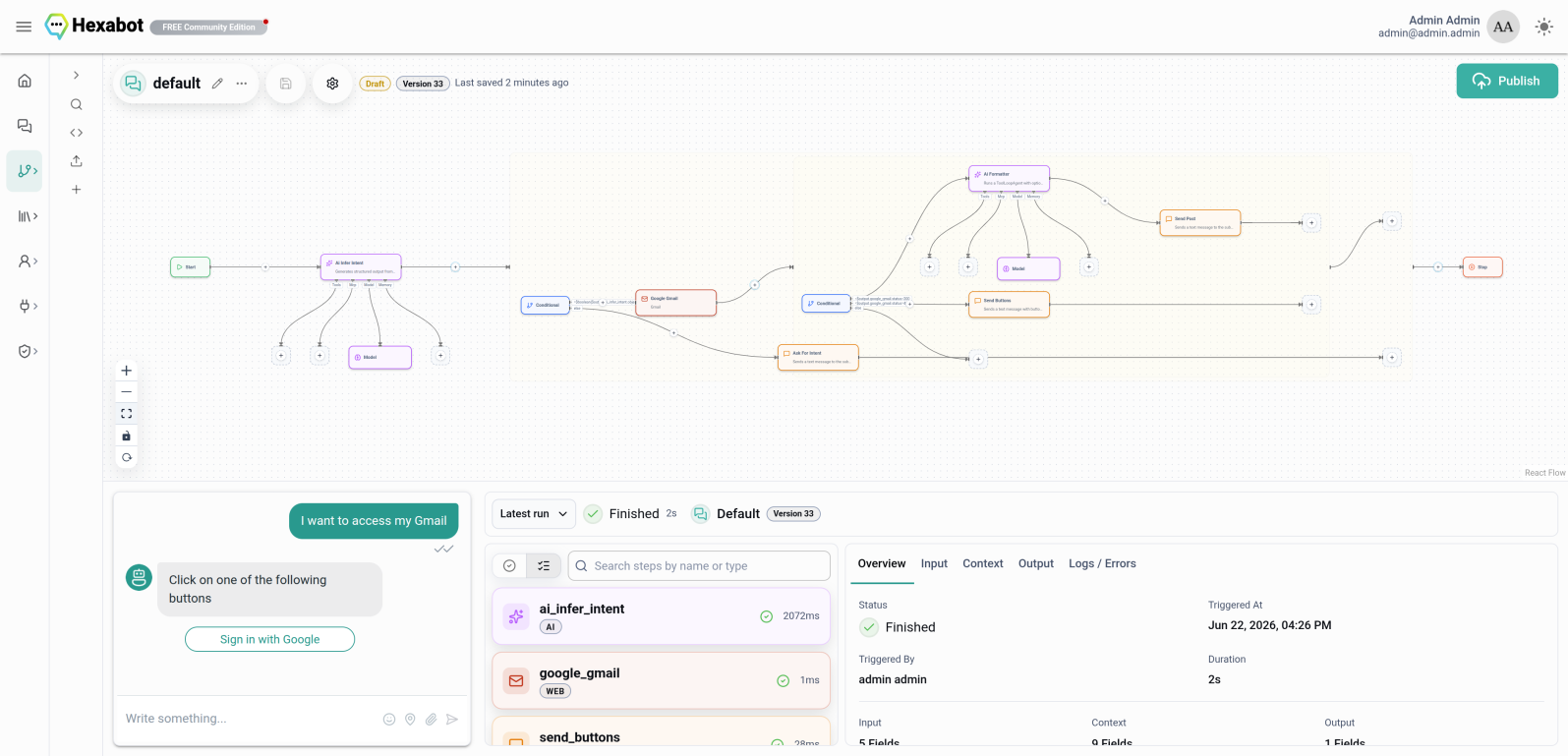
Most AI automations start as a few prompts glued together with scripts.
That works for demos. It breaks in production.
Agentic workflows are different. They allow AI systems to plan, make decisions, use tools, evaluate outputs, retry steps, coordinate specialized agents, and adapt based on context. But without the right foundation, agentic systems quickly become hard to debug, hard to maintain, and risky to operate.
Hexabot gives you a structured way to build agentic AI systems with the flexibility of large language models and the reliability of software engineering.
An agentic workflow is an AI-powered process in which one or more agents can reason through a task, decide what to do next, use tools, access memory, and iterate toward a goal — instead of following a single fixed script. Unlike traditional automation, agentic workflows adapt to the situation based on inputs, context, and intermediate results.
Every agentic workflow combines four building blocks: reasoning (the model plans and decides), tools (actions and MCP integrations that let it act on real systems), memory (persistent context across steps and sessions), and iteration (the ability to evaluate, retry, and refine until the goal is met).
Follows a fixed, predefined script. Reliable for repetitive, predictable tasks, but brittle when inputs vary or a step requires judgment.
Plan, decide, call tools, remember context, and adapt at runtime. Suited to processes with judgment, ambiguity, or multiple dynamic steps — while still staying observable and controllable.
They are useful when a process involves judgment, context, multiple steps, or dynamic decision-making.
Core patterns
Hexabot supports the core patterns used in modern agentic AI systems.
Build agents that can act independently by giving them access to AI reasoning, persistent memory, deterministic actions, and MCP-enabled tools.
Break complex tasks into multiple AI steps, where each step builds on the previous one for better quality and clearer reasoning boundaries.
Use AI to classify requests, extract structured information, and route workflows to the right branch with deterministic control.
Run multiple independent agents, actions, or tool calls at the same time, then combine their results for efficient execution.
Create a supervisor agent that delegates work to specialized agents or tools, each with a focused role.
Let agents generate outputs, evaluate them, improve them, and repeat until quality criteria are met.
Key capabilities
Hexabot is designed for teams that want to build AI agents that are powerful enough for complex work, but structured enough for production.
Native do, conditional, parallel, and loop primitives make it possible to model advanced agent behavior without custom scripts.
Use AI inside workflows as a proper action with structured inference, object extraction, and classification.
Give agents access to persistent context across sessions and workflow runs for more relevant responses.
Connect agents to tools through Model Context Protocol for standardized external capabilities.
Build workflows visually for speed and clarity, or use YAML for portability, version control, and code review.
Control your infrastructure, data, models, integrations, and deployment strategy with self-hosted architecture.
Use cases
From customer support to research agents, build AI systems that can handle complex, multi-step tasks.
Automate support triage, knowledge retrieval, account checks, response generation, and human escalation.
Research prospects, classify intent, score leads, enrich CRM records, and route opportunities to the right team.
Run multiple research agents in parallel, collect information from tools, synthesize findings, and refine reports.
Create scheduled agents that monitor systems, check data, trigger actions, summarize changes, and notify teams.
Build workflows for extraction, validation, classification, routing, approval, and follow-up with AI and human review.
Design conversational workflows that combine chatbot experiences, backend actions, AI reasoning, memory, and handoff.
Production-ready features
Everything you need to build, deploy, and maintain agentic AI systems that work reliably in production.
Support for autonomous agents, prompt chains, routing, parallel execution, orchestrator systems, and evaluator-optimizer loops.
Understand what happened at every step with run history, intermediate outputs, traces, decisions, and tool calls.
Keep humans involved where judgment, approval, or escalation is needed with inbox, handoff, and review steps.
Trigger workflows from chat, APIs, forms, schedules, events, webhooks, and messaging channels.
Run Hexabot on your own infrastructure and keep control over data, integrations, models, and security requirements.
Define agent behavior explicitly, combine AI and deterministic actions, version workflows as YAML, and maintain control.
Agentic AI should not mean uncontrolled AI.
Hexabot is built for teams that want to move fast without turning their operations into a black box.
Define agent behavior explicitly
Combine AI and deterministic actions
Keep humans in the loop
Inspect workflow execution
Version workflows as YAML
Connect tools through MCP
Self-host your infrastructure
Maintain control over data and deployment
Frequently asked questions
Common questions about building production-grade agentic workflows with Hexabot
An agentic workflow is an AI-powered workflow where one or more agents can reason, use tools, remember context, make decisions, and iterate toward a goal. It is more flexible than a traditional automation because the agent can adapt based on inputs, context, and intermediate results.
A chatbot usually focuses on conversation. An agentic workflow can include conversation, but it can also perform backend tasks, call tools, route decisions, run in the background, process documents, trigger APIs, and coordinate multiple agents. Hexabot supports both conversational AI and workflow automation, making it possible to build agents that talk, act, and integrate with real systems.
Yes. Hexabot can be used to build orchestrator-style workflows where a supervisor agent delegates tasks to specialized agents, actions, or MCP tools. You can also use memory and workflow state to coordinate context across steps.
Yes. Hexabot supports MCP tool integration, allowing agents to access standardized external capabilities through the Model Context Protocol.
Yes. Hexabot includes a visual builder for designing and debugging workflows. You can also define workflows as YAML for portability, version control, and engineering review.
Yes. Hexabot is designed to be self-hosted, giving your team control over deployment, data, integrations, and infrastructure.
Yes. Hexabot supports human-in-the-loop patterns such as inbox, handoff, and review steps. This is useful when workflows require approval, escalation, or human judgment.
You can build intelligent support agents, lead qualification workflows, research agents, internal operations agents, document processing workflows, AI-powered customer journeys, and multi-agent automation systems.
Agentic AI is powerful, but production systems need more than prompts.
They need structure, memory, tools, observability, human oversight, and deployment control.
Hexabot — where AI flexibility meets engineering reliability.